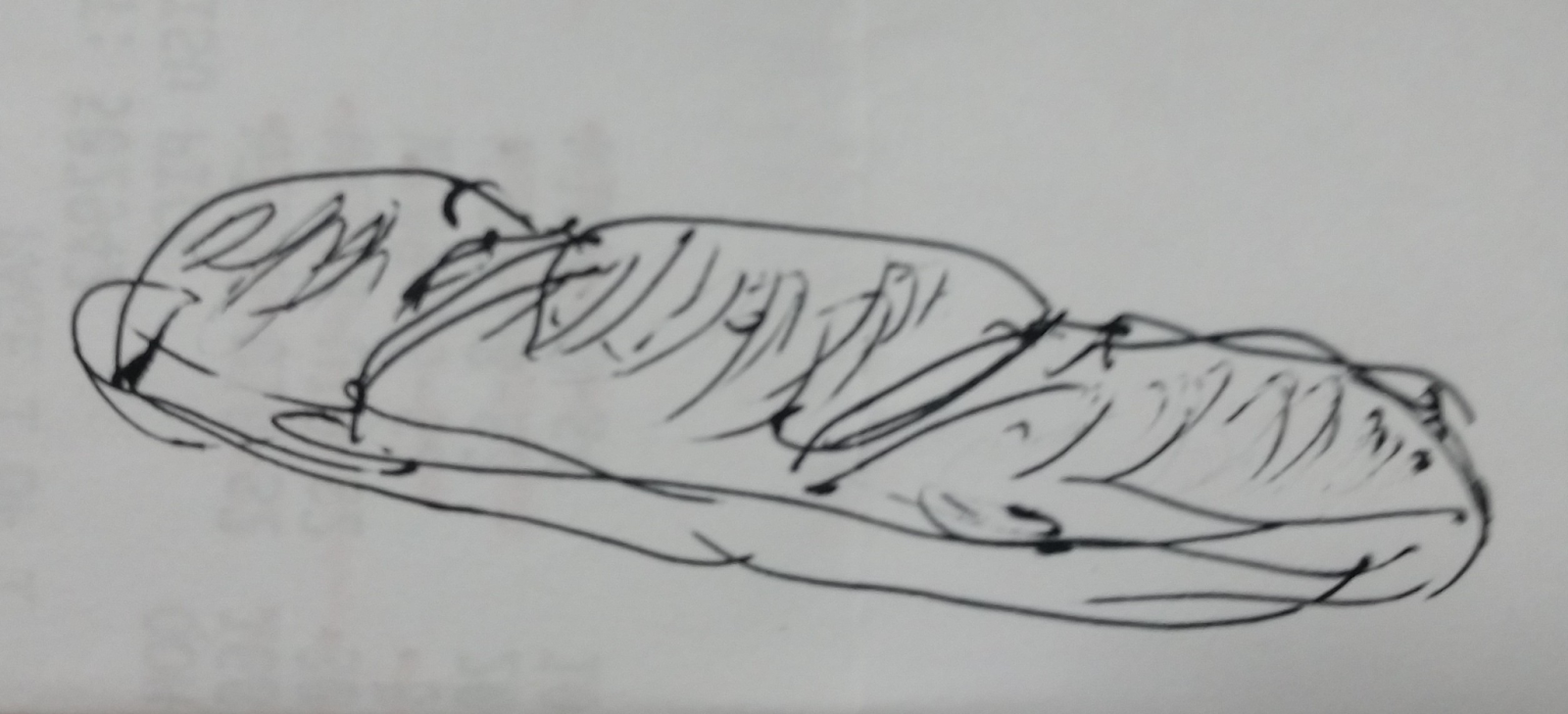
Today's prompt was 'loaf of bread'.
Monday, August 8, 2022

Sunday, August 7, 2022
Trying something a little different
Making triangle faces of a world polyhedron. I will start with a world surface area and get the diameter, radius and circumference. The world div would then be a rectangle circumference/100 km pixels wide and circ/200 km pixels tall. Diameter will be the square root of surface area in m. km^2/pi, rounded to the nearest tenth of a kilometer.
Saturday, August 6, 2022

Friday, August 5, 2022
Clickable Triangle Divs
Making clickable (adjacent) divs, starting with a red/green triangle
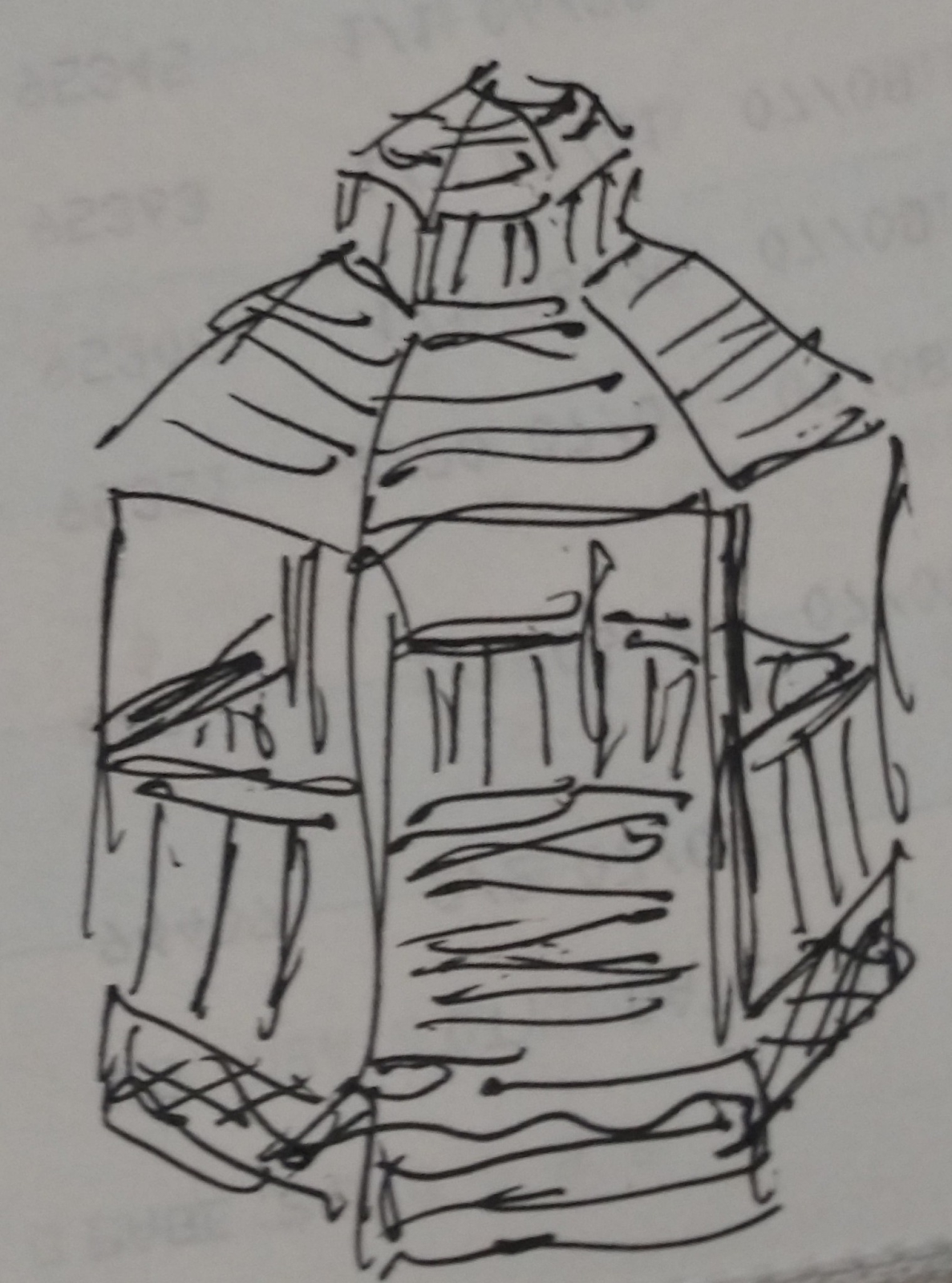
Today's prompt was 'greenhouse'. I drew the inside of a small one with benches or shelves, which is more my speed anyway...

I still want to make an exploration game, like a hexcrawl, only it's about arcs of territory you can go to the horizon and then beyond... 8-P I can build out adjacent triangles and have four clickable divs for movement. As the user clicks and chooses an adjacent triangle, the page changes the clickable divs around so that the other divs are now adjacent to the chosen triangle. If a triangle has open edges, the page makes an adjacent triangle for that edge and closes it. if there's a small concavity, less than 90 degrees or half pi, we can make a triangle to close it. The arc of exploration means that I should know what triangles are adjacent to the three triangles adjacent to the central triangle, but this is overkill for the initial game.
Thursday, August 4, 2022
From top to bottom...
Going to make yet another run at the World Peach Polyhedron, a
modified UV sphere with quads carved out of longitude and lattitude.
The average world surface area would be some random number plus 1/2 Earths,
.5 to 1.5 with a circumference of roughly .7 to 1,2 Earths. We're going to
work our way from the North (or South) Pole to the antipodes.
I'm going to start with a few percent of the worlds' surface for that polar
row. This initial bit of land or sea may be some fraction of that top row,
between .5 and 1.5 of that top row, so that roughly half the time the pole
starts out as one single bit of land or sea.
Subscribe to:
Posts (Atom)